

Quick Summary
The best non-toxic sanitizer for baby skin is one labeled for skin use, with a short ingredient list and no added fragrance or essential oils. Check the active ingredient and warnings on the back label, since "non-toxic" is a marketing phrase, not a standardized guarantee.
- Confirm the label says the product is for skin; surface disinfectants should never touch a baby's skin.
- Scan the inactive ingredients for fragrance, essential oils, and dyes, which are common irritants.
- Alcohol-based sanitizers can dry thin infant skin with frequent use, so consider alcohol-free options.
- Use plain soap and water when available, since it avoids the drying trade-off of sanitizers.
- Store all sanitizer containers out of reach, and call Poison Control at 1-800-222-1222 if a child swallows or gets it in the eyes.
Table of Contents
- Why Baby Skin Needs a Gentler Sanitizer
- What Makes a Sanitizer Suitable for Babies
- Sanitizer Ingredients to Avoid for Babies
- Alcohol-Based Versus Alcohol-Free Sanitizers
- Hypochlorous Acid Spray for Babies: How It Works and Where It Fits
- How to Sanitize Baby Toys Safely
- Using Sanitizer Safely Around Babies and Young Children
- Choosing Your Baby's Sanitizer Setup
- Frequently Asked Questions
Why Baby Skin Needs a Gentler Sanitizer
Infant skin is thinner and more permeable than adult skin, and its protective barrier is still developing, so a good non-toxic sanitizer matters from the start. That makes it more prone to dryness, irritation, and rashes.
Frequent cleaning compounds the problem. Hands get washed and sanitized many times a day, and each round can strip natural oils. The aim is not to skip hygiene. It is to choose a formula that disinfects without adding unnecessary irritants.
What Makes a Sanitizer Suitable for Babies
A baby-suitable sanitizer usually has a short ingredient list, no added fragrance, and a formula designed for repeated use. Look for clear labeling about what the product is for, since a hand product and a surface disinfectant are not interchangeable.
Pay attention to the claims behind the label. "Gentle" and "natural" are marketing terms without a fixed meaning. Product directions, the warning label, and any third-party certifications tell you far more. Where a certification is cited, check that it is current.
Sanitizer Ingredients to Avoid for Babies
"Non-toxic" is not a standardized, legally defined guarantee on a sanitizer label. It is a marketing phrase, so two products calling themselves a non-toxic sanitizer can have very different ingredient lists. The practical move is to read the back label the way a clinician would: active ingredients first, then inactives, then directions and warnings.
Start with the active ingredient
The active ingredient is what actually kills germs, and its name and concentration are required on the label. Common actives in skin sanitizers include ethyl alcohol (ethanol), isopropyl alcohol, and benzalkonium chloride. Each has a different profile:
- Ethyl alcohol is the most widely used skin sanitizer active. It acts quickly by denaturing proteins and dissolving germ membranes. At high concentrations and with frequent use it is drying, which matters for thin infant skin.
- Isopropyl alcohol behaves similarly but is more commonly found in surface and first-aid products; check whether the product is labeled for skin.
- Benzalkonium chloride is an alcohol-free active used in some hand sanitizers. It is gentler on skin than alcohol for some users but works more slowly and is inactivated by some soils, so label directions matter.
Inactive ingredients that deserve scrutiny
The inactive list is where irritation often hides:
- Fragrance and parfum, an umbrella term that can stand for dozens of undisclosed compounds. Fragrance is a common trigger for contact reactions on sensitive skin.
- Essential oils (lavender, tea tree, citrus, peppermint, eucalyptus), often marketed as natural, but they contain volatile compounds that can irritate or sensitize skin, and some are not recommended around infants.
- High alcohol content without moisturizers, drying, especially with repeated daily use.
- Quaternary ammonium compounds (often listed as benzalkonium chloride in surface products, or as alkyl dimethyl benzyl ammonium chloride), common in hard-surface disinfectants. These are designed for surfaces, not for application to a baby's skin.
- Strong oxidizers such as bleach (sodium hypochlorite) and hydrogen peroxide at disinfecting concentrations, surface products, not skin products.
Ingredients that are usually fine, and why "natural" is not the test
Humectants and emollients such as glycerin, aloe, and panthenol can offset dryness. But "natural" and "plant-based" are not safety categories: poison ivy is natural. Evaluate each ingredient on its own evidence, not on its origin story.
How to check a label in 60 seconds
- Confirm the product is labeled for skin. If the directions say "hard surfaces" or "do not apply to skin," it is not a hand sanitizer, no matter how gentle the front label sounds.
- Read the active ingredient and percentage. This tells you what kills germs and roughly how drying it will be.
- Scan the inactive list for fragrance, essential oils, and dyes. Fewer is generally easier on sensitive skin.
- Read the warnings and first-aid section. A legitimate skin product will tell you what to do after eye contact or swallowing.
- Check for third-party certification if the brand cites one (for example, National Eczema Association acceptance). Verify it is current on the certifying organization's site rather than trusting the badge alone.
Accidental ingestion and eye exposure are real risks with any cleaning or sanitizing product. Store everything out of reach, and keep the label accessible so you can read first-aid directions quickly if needed.
Alcohol-Based Versus Alcohol-Free Sanitizers
Alcohol-based sanitizers, typically using ethyl alcohol, are widely used. The trade-off is drying, especially with frequent use. Alcohol-free options avoid that dryness but may work differently against certain germs, so check the label for the organisms each product claims to address.
For a baby, many parents prefer an alcohol-free formula for routine skin contact. Alcohol-based products are generally kept for situations where soap and water are not available, and they should never be used on a baby's eyes or mouth.
Hypochlorous Acid Spray for Babies: How It Works and Where It Fits
Hypochlorous acid (HOCl) is a compound the body naturally produces as part of its immune response. You can see the specific HOCl mist product that uses it in Hand and Face Defense+.

It is best understood as a gentle option for skin and light-contact surfaces, not a replacement for handwashing with soap and water.
The article's key product facts for the hypochlorous acid option are summarised below.
| Product | Key feature | Use |
|---|---|---|
| Baby Skin Rescue + | Hypochlorous acid, alcohol-free, fragrance-free | Gentle option for skin and light-contact surfaces |
| Baby Skin Rescue + | Listed price: $14.99 | Check directions for frequency and approved surfaces |
| Hand & Face Defense+ Refill + Atomizer System | 3.4 oz size, listed at $34.99 | Refillable setup |
| Hand & Face Defense+ Refill | 8 oz size, listed at $39.99 | Compare ingredients and directions before buying |
How to Sanitize Baby Toys Safely
Toys need a different approach from skin. For a disinfecting step, use a product labeled for that surface and follow the contact time on the label. Cinagro™ Pro Surface Ready-To-Use Solution is one option that sanitizes, disinfects, and deodorizes surfaces in a single step.
Soft toys and plush items are often better cleaned by machine or hand washing, following the care tag. Replace any toy with cracks or crevices that trap moisture, since those are hard to clean fully.
Using Sanitizer Safely Around Babies and Young Children
Safety guidance changes with a child's age, mobility, and hand-to-mouth habits. A single set of rules for "babies" is too blunt to be useful.
Infants (under about 6 months)
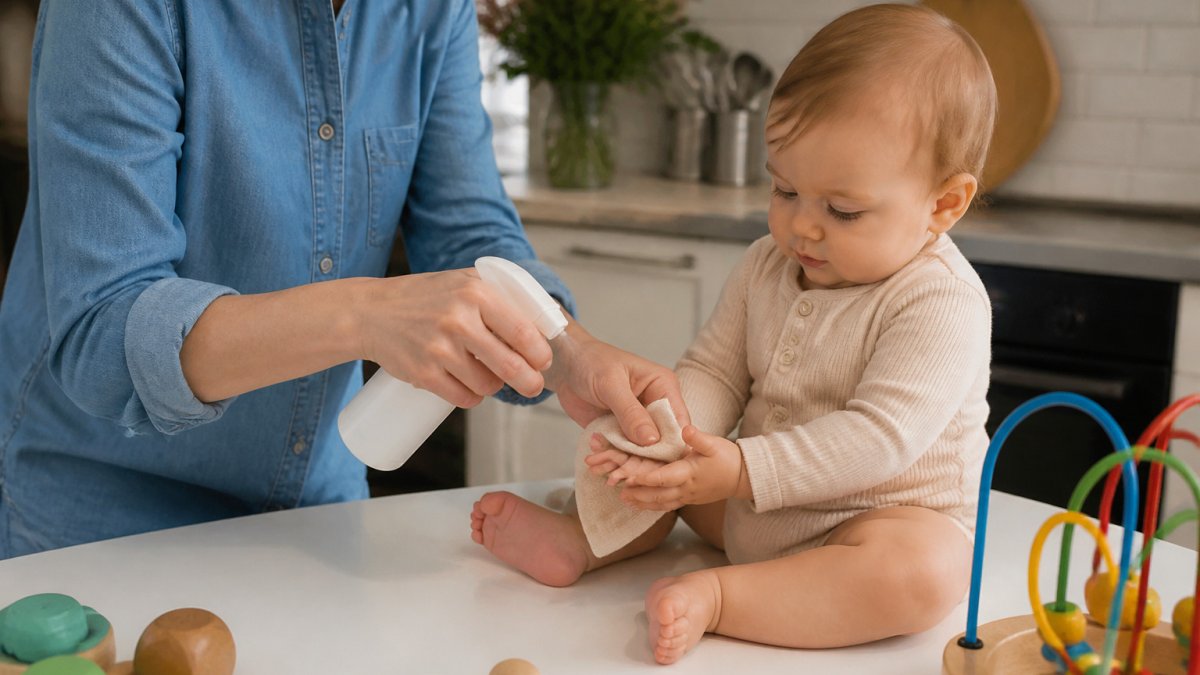
Infants cannot apply or avoid products themselves, so the risk is entirely about what caregivers bring into contact with them. Apply sanitizer to your own hands, let it dry completely, and then handle your baby. Avoid applying hand sanitizer directly to an infant's skin unless a clinician has specifically recommended it; soap and water is the default for cleaning a baby's hands. Keep all containers, including pump bottles and sprays, well out of reach, infants explore by mouthing.
Crawlers and toddlers (roughly 6 months to 3 years)
This is the highest-risk window because mobility arrives before judgment. Toddlers will pick up bottles, press spray triggers, and put hands in their mouths. Practical steps:
- Store sanitizer and disinfectant sprays in a locked or high cabinet, not under the sink.
- Avoid spray formats around toddlers; a pump or wipe reduces the chance of aerosolized product reaching eyes or mouth.
- Never leave a bottle open or within reach "just for a second" during diaper changes or meals.
- Supervise use of sanitizer on a toddler's hands, and rub hands together until dry rather than letting the child lick or wipe them.
Preschool and older children
Children this age can learn to use sanitizer with supervision. Teach them to rub hands until dry, to keep hands away from eyes and mouth until dry, and to tell an adult if product gets in their eyes or mouth. Keep the container size appropriate, small travel bottles are easy for a child to squeeze excessively.
If product gets in the eyes
Eye exposure is painful and time-sensitive. Flush the eye with clean, lukewarm water for the time specified on the product label (commonly around 15 minutes), hold the eyelid open, and remove contact lenses if present and easy to do. Then call Poison Control at 1-800-222-1222 or seek medical care (Contact us). Do not rub the eye.
If a child swallows sanitizer
Do not induce vomiting. Read the label's first-aid section, rinse the mouth if the child is awake and able, and call Poison Control at 1-800-222-1222 immediately. Have the product container in hand so you can read the active ingredient and concentration to the specialist. Symptoms to watch for include drowsiness, vomiting, and irritation of the mouth or throat.
Skin irritation, eczema, and frequent use
Frequent sanitizing can strip oils and worsen dryness, and eczema-prone skin may flare. Signs to watch for include redness, itching, cracking, and new rash in areas of contact. If irritation appears, stop using the product and switch to soap and water where feasible. For a baby with diagnosed eczema, ask your pediatrician or dermatologist which products are appropriate before routine use, a clinician who knows the child's skin is a better guide than any front-label claim.
Keep skin and surface products separate
The most common household mistake is using one bottle for everything. Keep a skin-labeled sanitizer for hands and a surface-labeled disinfectant for toys and high-touch surfaces, store them in different places, and never decant one into the other's bottle.
Choosing Your Baby's Sanitizer Setup
Most families do well with two products: one gentle option for hands and skin, and one labeled disinfectant for toys and frequently touched surfaces. You can browse the full range of products designed for babies and young children to compare options. Keep them clearly separated and stored safely.
If you want a skin-focused option, Baby Skin Rescue + is listed at $14.99 as alcohol-free and fragrance-free.

Frequently Asked Questions
Is hand sanitizer safe for a baby's skin?
Many hand sanitizers are not designed for infants. Alcohol-based formulas can dry and irritate delicate skin, and fragrance adds another possible irritant. Look for alcohol-free, fragrance-free products labeled for sensitive or baby skin, and use them under adult supervision. Soap and water remains the best choice when hands are visibly dirty, and sanitizer should never be the only hygiene step for a newborn in a household with frequent hand contact.
What ingredients should I avoid in baby hand sanitizer?
Avoid products containing ethyl or isopropyl alcohol at high concentrations, added fragrance and essential oils that can irritate skin, and harsh antimicrobial agents. Check the active ingredient list and the warning label, and watch for parabens or other preservatives if your baby has eczema. Patch-testing a small area before full use is a practical step for any new product.
Is hypochlorous acid safe for babies' skin?
Hypochlorous acid spray marketed for babies, such as Baby Skin Rescue +, is formulated to be alcohol-free and fragrance-free and is designed for gentle use on skin. Follow the product directions, avoid spraying in the eyes or mouth, and keep the bottle out of reach of young children. Test on a small area first if your child has eczema or a known sensitivity.
What is the difference between hand sanitizer and surface disinfectant?
Hand sanitizer is designed for skin and is used on hands, while surface disinfectant is designed for toys, counters and other objects and is not meant for skin contact. Using a surface product on skin can cause irritation, and using a hand product on toys may not provide the same surface coverage. Choose each product for its intended use and read the label before use.


