

Table of Contents
- Hypochlorous Acid vs Alcohol Sanitizer: What Actually Matters
- Quick Comparison: HOCl vs Alcohol at a Glance
- How Each One Kills Germs: HOCl vs Alcohol Mechanisms
- HOCl Skin Safety: Why Sensitive Skin Reacts Differently
- How to Use Hypochlorous Acid Spray on Hands and Surfaces
- Hypochlorous Acid Shelf Life and Storage Requirements
- Cost-per-Use Analysis: Which Sanitizer Is Worth It?
- The Verdict: Choosing the Right Sanitizer for Your Family
- Frequently Asked Questions
Last Updated: September 9, 2026
Hypochlorous Acid vs Alcohol Sanitizer: What Actually Matters
Alcohol-based sanitizers dry out your skin, sting open cuts, and lose effectiveness the moment they evaporate. Hypochlorous acid (HOCl) kills pathogens just as effectively while your body actually produces this exact molecule to defend and repair skin. The science consistently points to HOCl as the gentler, more versatile choice.
Hypochlorous acid vs alcohol sanitizer comes down to one core question: do you want to sanitize at the expense of your skin barrier, or work with your body’s natural defense system? HOCl is a weak acid produced by white blood cells to fight infection and reduce inflammation. Alcohol, typically ethanol or isopropyl alcohol at 60-70% concentration, kills by denaturing proteins but offers zero skin benefit (the CDC).
Below, we break down the mechanisms, skin safety, application methods, storage requirements, and true cost-per-use of each option.
Quick Comparison: HOCl vs Alcohol at a Glance
| Factor | Hypochlorous Acid (HOCl) | Alcohol Sanitizer |
|---|---|---|
| Kill Mechanism | Oxidizing agent, disrupts pathogens | Protein denaturation |
| Skin Impact | Gentle, supports skin barrier | Drying, can cause irritation |
| Concentration | Typically 50-200 ppm | 60-70% alcohol |
| Contact Time | 30-60 seconds | 20-30 seconds |
| Residue | None, evaporates clean | None, evaporates fast |
| Safe for Kids | Yes, non-toxic | Risk if ingested |
| Surface Safe | Food-contact safe | Can damage some surfaces |
| Shelf Life | Needs stable packaging | Long, stable |
The table summarizes what matters most, but the real differences run deeper: HOCl offers broad-spectrum antimicrobial activity without the cytotoxicity that makes alcohol problematic for sensitive skin.

How Each One Kills Germs: HOCl vs Alcohol Mechanisms
Alcohol sanitizers work through protein denaturation. When ethanol or isopropyl alcohol contacts bacteria or viruses, it unfolds their proteins and disrupts their lipid membranes. This process is fast and effective, but it stops working immediately after evaporation, leaving no residual protection.
Hypochlorous acid works differently. As an oxidizing agent, HOCl attacks the cell walls of pathogens, disrupting protein synthesis and damaging their DNA. The undissociated HOCl molecule carries no charge, allowing it to penetrate bacterial cell membranes more effectively than other chlorine-based compounds.
What most guides miss is the selectivity of HOCl. Your immune system produces this exact molecule, meaning human cells recognize it as safe while pathogens cannot defend against it. Alcohol makes no such distinction, damaging your skin’s barrier along with any germs present.
This mechanism difference explains why HOCl demonstrates virucidal and bactericidal activity at parts per million concentrations while remaining biocompatible with human tissue.
HOCl Skin Safety: Why Sensitive Skin Reacts Differently
The skin barrier is your first line of defense, and alcohol compromises it with every use. Frequent application strips natural oils, disrupts pH balance, and can trigger eczema flare-ups.
Hypochlorous acid vs alcohol on skin is not a close contest. HOCl maintains the skin’s natural pH balance while delivering antimicrobial protection. Dermatological safety studies consistently show HOCl reduces dermal irritation rather than causing it, which is why dermatologists increasingly recommend it for patients with compromised skin barriers.
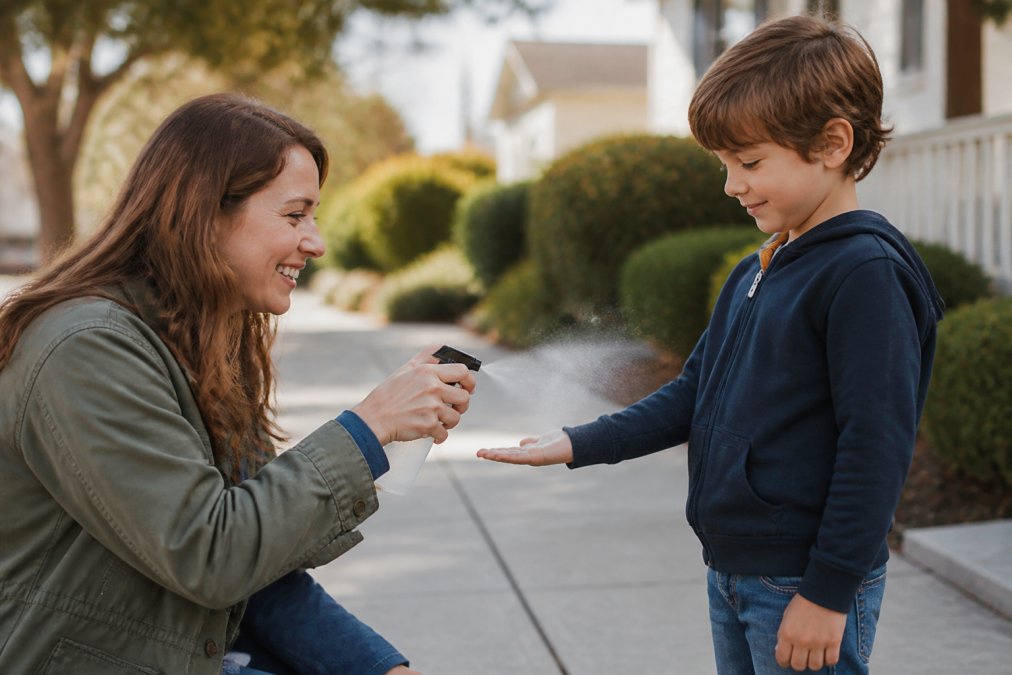
Beyond Clean’s Hand & Face Defense+ delivers HOCl at a concentration gentle enough for daily use on infants and children. The formula is fragrance-free, alcohol-free, and accepted by the National Eczema Association, so you can sanitize a child’s hands before meals or after playground time without worrying about dryness or stinging.

For adults with chronic skin sensitivities, switching from alcohol to HOCl often resolves the cracking and irritation that frequent sanitizing causes. The clinical efficacy matches alcohol, but without the cytotoxicity that damages skin over time.
How to Use Hypochlorous Acid Spray on Hands and Surfaces
Using HOCl spray correctly determines whether you get full antimicrobial coverage or miss critical areas.
For hands: Spray 2-3 pumps directly onto dry hands, rub thoroughly for 30 seconds covering all surfaces including between fingers and under nails, then allow to air dry. Do not wipe off, as this removes the active ingredient before it finishes working.
For surfaces: Spray directly onto the surface from 6-8 inches away, ensuring complete coverage. Allow 30-60 seconds of contact time before wiping. For food preparation areas, HOCl is food-contact safe and requires no rinse, making it ideal for kitchen counters and cutting boards.
The versatility of hypochlorous acid spray extends beyond typical sanitizer use. Many families use it on produce, high-chair trays, pacifiers, and even gym equipment. Because HOCl is non-toxic and biodegradable, you don’t need to worry about chemical residue near where your family eats or plays.
Hypochlorous Acid Shelf Life and Storage Requirements
This is where HOCl gets a bad reputation, and partially deserved. Hypochlorous acid is inherently unstable compared to alcohol. The molecule breaks down over time, reverting to water and salt, so shelf life depends heavily on packaging and storage conditions. eco-friendly cleaning methods.
But the real story is more specific than "keep it out of the sun." Understanding the degradation chemistry helps you buy smarter and store better.
Why HOCl Degrades: The Chemistry
HOCl is a weak acid in equilibrium with hypochlorite ion (OCl⁻) and chlorine gas. That equilibrium shifts based on three factors: pH, temperature, and light exposure.
- pH Stability Window: HOCl is most stable at a slightly acidic pH between 5.0 and 6.5 (peer-reviewed research). Below pH 4, it rapidly converts to chlorine gas and escapes. Above pH 7.5, it shifts toward the less effective hypochlorite ion. Quality manufacturers buffer their formulas to hold this window.
- Temperature Sensitivity: Every 10°C (18°F) increase in storage temperature roughly doubles the degradation rate (PubMed). A bottle left in a car at 120°F loses potency 8 times faster than one stored at 70°F.
- UV Light: Ultraviolet light catalyzes the breakdown of HOCl into hydrochloric acid and oxygen. This is why clear bottles are a red flag unless they use UV-absorbing glass or the product is meant for immediate use.
- Headspace Oxygen: Oxygen in the bottle's headspace oxidizes HOCl over time. Quality packaging uses minimal headspace or nitrogen flushing to displace oxygen before sealing.
What "12-24 Month Shelf Life" Actually Means
A 12-24 month shelf life claim assumes specific conditions: sealed container, room temperature (68-77°F), and no direct light exposure. Once you open the bottle, the clock accelerates because every spray introduces air into the headspace.
An unopened bottle maintains 90%+ of its labeled concentration for 18 months, but an opened bottle used daily may drop to 80% potency by month 6. That's still effective for most pathogens, but it's worth knowing.
Practical Storage Rules for Home Use
- Store HOCl spray in a cool, dark cabinet, not on a sunny windowsill or bathroom counter.
- Keep the cap tightly sealed between uses.
- Write the opening date on the bottle with a marker.
- Replace any bottle that has been exposed to extreme heat (like a parked car in summer) for more than a few hours.
- Buy smaller bottles if you use HOCl infrequently. A 3.4-ounce bottle used weekly will finish long before degradation matters.
How to Test If Your HOCl Is Still Active
Most consumers can't measure ppm at home, but there are practical indicators:
- The sniff test: Active HOCl has a very faint chlorine scent. If it smells strongly of bleach, the pH has drifted and it's converting to hypochlorite. If it smells like nothing at all, it may have fully degraded to salt water.
- The fizz test: Spray a small amount on a cut or scrape. Active HOCl produces a mild, brief fizzing sensation as it reacts with organic material. No sensation at all may indicate low potency.
- Expiration dating: Reputable manufacturers print both a manufacturing date and an expiration date. If you only see one date, assume it's the manufacturing date and calculate 18-24 months from there.
Alcohol sanitizers, by contrast, remain stable for years in almost any conditions. This stability advantage is real, but it comes with the trade-off of skin damage and surface incompatibility.
For most families, the shorter shelf life of HOCl is manageable with proper storage habits. Treat HOCl like a perishable good: buy fresh, store cool, and use it within a year of opening.
Cost-per-Use Analysis: Which Sanitizer Is Worth It?
The upfront price difference between HOCl products and generic alcohol sanitizers can feel shocking. A $3 bottle of hand sanitizer versus a $16.99 bottle of Beyond Clean Hand & Face Defense+ seems like an obvious choice, until you examine how much product each application actually requires.
But a real cost-per-use analysis goes deeper than the sticker price.
The Per-Use Math, Done Properly
Alcohol sanitizer: The CDC recommends using enough to cover all hand surfaces, which typically means 2-3 mL per application. A standard 8-ounce (237 mL) bottle provides roughly 80-120 uses. At $3.00 per bottle, that's $0.03 per use. But there's a hidden variable: alcohol evaporates quickly. If you apply less than the recommended amount because it feels wasteful, you're getting incomplete coverage, which means you're not actually sanitizing.
HOCl spray: A 3.4-ounce (100 mL) bottle of Beyond Clean Hand & Face Defense+ delivers roughly 300-400 sprays. Each hand sanitization requires 2-3 sprays, yielding about 100-130 uses per bottle. At $16.99, that's approximately $0.13-0.17 per use.
The Bulk Buying Factor
Families don't buy one bottle at a time. Here's where the economics shift significantly:
- Alcohol in bulk: A 32-ounce refill of generic alcohol sanitizer costs about $8-10 at warehouse clubs, yielding roughly 400-500 uses. That drops the per-use cost to $0.02.
- HOCl in bulk: Beyond Clean's refill system, the HAND AND FACE DEFENCE+ REFILL + ATOMIZER 3.4/8 OZ at $34.99, provides a reusable mister plus an 8-ounce refill. That refill delivers roughly 800-900 sprays, or about 250-300 hand sanitizations. The per-use cost drops to approximately $0.12, and subsequent refills cost less because you already own the atomizer.
The Hidden Cost of Alcohol: Skin Damage
This is the line item most cost comparisons ignore. Alcohol's drying effect isn't just uncomfortable, it's expensive.

- Moisturizers: Families with alcohol-sensitive skin typically add a hand cream or lotion to their routine. A basic fragrance-free moisturizer costs $8-12 per bottle and lasts 4-6 weeks with daily use after sanitizing. That's $70-150 per year.
- Dermatologist visits: For families with eczema-prone children, frequent alcohol sanitizer use can trigger flares requiring medical visits. A single dermatology copay ranges from $30-75, and prescription barrier creams cost $40-100 per tube.
- The total picture: A family of four using alcohol sanitizer 10 times per day collectively spends roughly $0.20 per day on sanitizer plus $0.30-0.50 per day on moisturizers and barrier repair, totaling $180-250 per year. The same family using HOCl spends about $0.40 per day on product with no additional moisturizer requirement, totaling roughly $145 per year.
The Verdict on Cost
| Sanitizer | Upfront Cost | Uses per Bottle | Cost per Use | Annual Cost (Family of 4) |
|---|---|---|---|---|
| Generic Alcohol Gel (8 oz) | $3.00 | ~100 | ~$0.03 | $110 + moisturizers |
| Alcohol Gel Bulk (32 oz) | $9.00 | ~400 | ~$0.02 | $75 + moisturizers |
| Beyond Clean Hand & Face Defense+ (3.4 oz) | $16.99 | ~110 | ~$0.15 | $200 |
| Beyond Clean Refill System (8 oz) | $34.99 | ~300 | ~$0.12 | $145 |
| Alcohol + Prescription Barrier Cream | $40-100 per tube | Ongoing | Higher total | $250-400 |
The real cost comparison includes what you spend managing alcohol's side effects. Families with eczema-prone children often spend more on prescription creams than they would on a full year of HOCl products. For those families, the choice isn't just about skin comfort, it's about the household budget.
The Verdict: Choosing the Right Sanitizer for Your Family
Hypochlorous acid vs alcohol sanitizer resolves to a simple recommendation: choose HOCl if you have children, sensitive skin, or want a sanitizer safe for both hands and food-contact surfaces. Choose alcohol only if you need maximum stability in extreme conditions and don’t mind the skin damage.
For most families, the decision is clear. HOCl offers comparable antimicrobial effectiveness with superior skin compatibility, no toxic residue, and environmental benefits through refillable systems. The Hand & Face Defense+ at $16.99 delivers professional-grade protection that’s gentle enough for babies yet effective for active lifestyles.
If you’re skeptical about switching, start with one bottle and use it for a week. Pay attention to how your hands feel compared to alcohol sanitizer. Most people notice the difference within days, especially during winter months when skin is already stressed.
The science behind hypochlorous acid is not new. Your body has been producing this molecule to fight infection since the beginning of human evolution. The only innovation is putting it in a bottle for everyday use.
Choosing between HOCl and alcohol sanitizer ultimately comes down to what you value: short-term convenience or long-term skin health. Beyond Clean offers a dermatologist-approved, fragrance-free solution powered by pure hypochlorous acid, with refillable atomizers that reduce plastic waste. Our formulas are clinically tested, accepted by the National Eczema Association, and safe enough for babies yet effective for active families. Get 15% off your first order and experience the difference of sanitizing that works with your body, not against it.
Frequently Asked Questions
Is hypochlorous acid better than alcohol for disinfecting?
For skin, hypochlorous acid offers comparable microbicidal activity to alcohol without the stinging or dryness. Alcohol at 60-90% concentration denatures proteins quickly, while HOCl oxidizes pathogens using the same mechanism your immune system employs. On surfaces, both are effective, but HOCl remains active longer and is non-flammable. The practical difference is skin tolerance: HOCl can be used dozens of times daily without damaging the skin barrier, making it the better choice for frequent hand hygiene.
Is there a downside to hypochlorous acid?
The main downside is shelf life. HOCl is inherently unstable and degrades over time, typically lasting 6-12 months in proper storage away from heat and direct sunlight. It also cannot be mixed with other cleaning agents, as contact with acids or ammonia produces harmful chlorine gas. Alcohol has an indefinite shelf life, but it damages skin with repeated use and evaporates quickly, leaving no residual protection. For most families, the stability trade-off is worth the skin safety benefits.
What concentration of hypochlorous acid is safe for skin?
Hypochlorous acid skin sprays typically contain 50-200 parts per million (ppm), which is both microbicidal and gentle on skin. Products in this range are non-toxic and non-irritating, making them suitable for frequent daily use on sensitive skin, including eczema-prone areas. Higher concentrations, around 500 ppm and above, are intended for surface disinfection rather than direct skin contact. Always check the label to confirm the ppm and intended use before applying any HOCl product.
Can hypochlorous acid be mixed with other skincare products?
Yes, HOCl is compatible with most skincare products, but apply it first and allow it to dry before layering moisturizers or serums. Avoid combining it with acidic products like vitamin C or AHAs in the same application, as the pH shift can reduce HOCl's antimicrobial activity. Do not mix HOCl with alcohol-based products, as this can cause skin dryness. To protect the skin barrier, apply a moisturizer after the HOCl spray has fully dried.


