


Last Updated: October 27, 2026
Quick Summary
Effective eco-friendly germ protection means cleaning first with castile soap to remove soil and bacterial load, then applying a sanitizer for its full dwell time. Cold water works as well as hot for hard surfaces, since chemistry and contact time kill germs, not heat. Choose products with verified claims, not vague natural labels.
- Use one teaspoon of castile soap per cup of warm water with a microfiber cloth before sanitizing.
- Spray 70% isopropyl alcohol until visibly wet and let it sit at least 30 seconds.
- Hydrogen peroxide 3% needs one minute of wet contact on cutting boards and bathroom fixtures.
- Avoid vinegar, bleach, and acidic cleaners on marble, granite, and travertine; use pH-neutral products only.
- Cinagro Pro Surface Defense is listed at $34.99 and Hand & Face Defense+ at $16.99.
Table of Contents
- Cleaning vs Sanitizing vs Disinfecting: What the Labels Actually Mean
- Eco-Friendly Germ Protection That Holds Up Against Real Pathogens
- How to Disinfect Surfaces Naturally Without Cutting Corners
- Choosing an Eco-Friendly Disinfectant Without Falling for Greenwashing
- Refillable Cleaning Products: The Plastic Waste Math
- Two Angles Most Guides Skip: Your Microbiome and Cold-Water Efficacy
- Building Your Family's Germ Protection Kit
- Frequently Asked Questions
Cleaning vs Sanitizing vs Disinfecting: What the Labels Actually Mean
The eco friendly germ protection guide starts with a vocabulary lesson. Cleaning removes visible soil and many germs. Sanitizing reduces bacteria to levels public health officials consider safe. Disinfecting kills nearly all pathogens, but only if the product stays wet for its full dwell time. Three jobs, three products, and the label tells you which one you bought.
A spray that cleans beautifully may do almost nothing to a virus, and a harsh disinfectant on a crib rail can leave residue a crawling baby will touch within minutes.
Dwell Time: The Number Most People Skip
Dwell time is how long a wet surface must stay wet for the product to hit its claimed kill rate. Read the back label and follow its instructions.
Why Bacterial Load Matters More Than a Single Spritz
A surface covered in food residue, grease, or grime shields germs from whatever you spray on it, which is why cleaning always comes before sanitizing. Reduce the bacterial load first with soap and mechanical action, then apply your sanitizer to a surface it can actually reach. Skip cleaning and even a strong disinfectant underperforms. This principle of removing organic debris before applying antimicrobial agents remains equally vital when sanitizing artificial grass to ensure that outdoor play areas stay hygienic for children and pets.
Eco-Friendly Germ Protection That Holds Up Against Real Pathogens
Effective eco-friendly germ protection is not about avoiding germs entirely. Skeptical readers can review the science and efficacy evidence behind these claims. But "natural" is not a synonym for "effective."
What Vinegar, Baking Soda, and Castile Soap Can and Cannot Do
Castile soap (a vegetable-oil-based soap, typically olive or coconut) lifts soil and germs so water can rinse them away, the same principle behind handwashing. Soap does not kill pathogens; it surrounds and lifts them so they rinse down the drain. Castile soap belongs in your caddy as a surfactant, but it does not replace a sanitizer when someone in the house is sick.
Three DIY Protocols That Actually Work (and Their Limits)
Here are the ratios, contact times, and limits of each protocol.
- Soap-and-water wash (the step everyone skips). One teaspoon of castile soap per cup of warm water, applied with a microfiber cloth, removes the soil and bacterial load that shields germs from any sanitizer. This is cleaning, not sanitizing, and it is the most underrated step in home hygiene.
- 70% isopropyl alcohol spray (for hard, non-porous surfaces). A 70% concentration (not 91%) penetrates cell walls more effectively because the water content slows evaporation and extends contact time. Spray until visibly wet and let sit for at least 30 seconds. Limits: it is flammable, degrades some plastics and finishes, is harsh on skin, and is not appropriate for food-contact surfaces you will not rinse.
- Hydrogen peroxide 3% (for cutting boards and bathroom fixtures). Spray until wet and let stand for one minute, then air-dry or rinse food-contact surfaces. Limits: it bleaches fabric, degrades some metals, and loses potency in light, so keep it in an opaque bottle.
Where Hypochlorous Acid Fits
Hypochlorous acid (HOCl) is naturally produced and released within white blood cells. Readers can learn what hypochlorous acid is and why it's used. Beyond Clean offers products powered by HOCl.
The Cold-Water Question Most Guides Ignore
Water temperature is a sustainability lever, not a germ-killing one. A home tap tops out around 120-140°F, and pathogens are not reliably killed at those temperatures in the seconds a surface stays wet. What kills germs is the chemistry and the dwell time, so you can wash and rinse with cold water, save the energy of heating it, and lose nothing in germ protection as long as your product and contact time are right. The one exception is laundry, where hot water helps remove body oils and improve detergent performance; for hard surfaces, cold water plus correct dwell time is the more sustainable and equally effective choice.
How to Disinfect Surfaces Naturally Without Cutting Corners
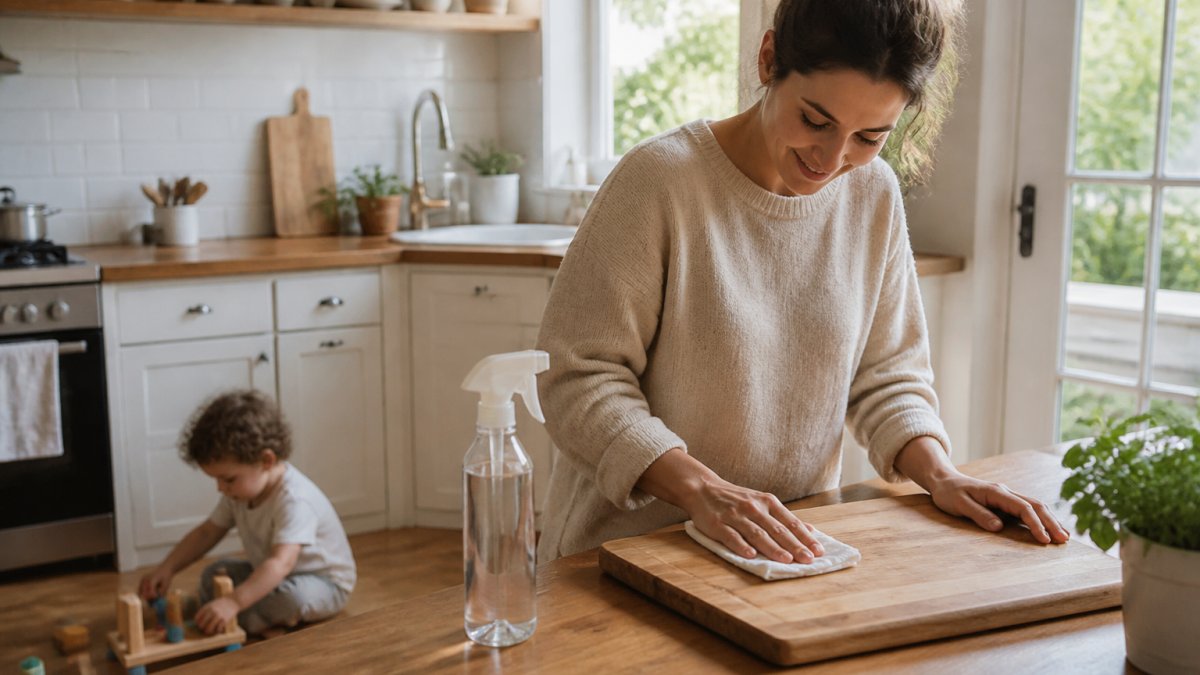
Natural disinfection works when you follow the same discipline a hospital cleaning crew uses: clean first, apply enough product, respect dwell time, and let it dry. The order matters more than the brand. Material specificity separates a guide that works from one that just sounds good: the same spray that is perfect on a laminate counter can ruin a marble backsplash or leave residue on a silicone teether. Here is the room-by-room playbook.
The Five-Step Protocol (Apply to Every Surface)
- Clear the surface of dishes, crumbs, and clutter.
- Wash with soap and water or a microfiber cloth to drop the bacterial load.
- Spray your sanitizer until the surface is visibly wet, not damp.
- Leave it for the full dwell time on the label.
- Air-dry or wipe with a clean cloth if the label permits.
Surface-by-Surface Guide: Kitchen, Bathroom, Nursery, and Electronics
Soft furnishings and upholstery. Harsh disinfectants leave residue that skin and lungs contact for hours, and they can strip the beneficial skin bacteria that help regulate moisture and defend against infection. For soft surfaces, focus on laundering removable covers, vacuuming with a HEPA filter, and using a fabric-safe sanitizer only when someone in the house is sick.
The Material Caveats That Save You a Repair Bill
- Natural stone (marble, granite, travertine): no vinegar, no bleach, no acidic anything. pH-neutral only.
- Hardwood and laminate: no standing water; spray the cloth, not the floor, and dry promptly to prevent warping and finish dulling.
- Stainless steel: avoid chlorine bleach, which can pit the surface; wipe with the grain.
- Silicone and food-grade plastic: rinse thoroughly after any sanitizer, since these materials can absorb residue.
- Sealed grout: avoid prolonged acid contact; a baking-soda paste is safer than vinegar for routine cleaning.
Choosing an Eco-Friendly Disinfectant Without Falling for Greenwashing
An eco-friendly disinfectant earns the label through verified claims, not leaf graphics. Greenwashing is rampant because terms like "natural" and "green" carry no legal definition on a cleaning product label.
Cinagro™ Pro Surface Defense →
Regulatory Standards for Natural Claims
The EPA's Safer Choice program verifies which ingredients meet its safer-chemistry standard, and the FTC's Green Guides set the rules for how environmental claims can be marketed. A product that says "EPA-registered" has passed efficacy review. A product that says "natural" has told you almost nothing. Look for ingredient transparency, third-party certification, and a clear statement of what the product kills.
Common Toxic Ingredients to Avoid
- Chlorine bleach, which irritates airways and damages fabric over time
- Quaternary ammonium compounds, which linger on surfaces
- Synthetic fragrance, a frequent trigger for skin sensitivities
- Alcohol at high concentrations, which dries hands and stings broken skin
- Volatile organic compounds that degrade indoor air quality
Refillable Cleaning Products: The Plastic Waste Math
Beyond Clean offers a refillable atomizer system designed to reduce single-use plastic waste. Readers can explore the brand's sustainability commitments and refill approach.
Two Angles Most Guides Skip: Your Microbiome and Cold-Water Efficacy
Two overlooked questions separate a good guide from a thorough one: what daily disinfecting does to your skin, and whether water temperature changes how well your cleaner works.
What Disinfectants Do to Your Skin Microbiome
Beyond Clean's Hand & Face Defense+ is formulated with HOCl and contains no alcohol.
Does Cold Water Actually Work?
Cold water cleans effectively when paired with the right product and enough mechanical action. Heat helps dissolve grease and wax, but it does not reliably kill pathogens at the temperatures a home tap delivers. What kills germs is the chemistry and the dwell time, not the steam off your sponge.
Building Your Family's Germ Protection Kit
A practical kit can include products for surfaces, hands, and faces. Readers can view and buy Hand & Face Defense+ as a core kit item. Readers assembling their kit can go straight to Cinagro™ Pro Surface Defense.


| Item | Job | Where It Lives |
|---|---|---|
| Surface sanitizer | Counters, tables, toys, door handles | Kitchen and nursery |
| Hand and face cleanser | On-the-go skin sanitizing | Purse and car |
| Refillable atomizer | Cuts single-use plastic | Pocket or backpack |
| Microfiber cloths | Mechanical cleaning before sanitizing | Every room |
For surfaces, Cinagro™ Pro Surface Defense is listed at $34.99. For skin, Hand & Face Defense+ is dermatologist tested and approved, accepted by the National Eczema Association, and TSA travel friendly; it is listed at $16.99.
Beyond Clean offers fragrance-free, alcohol-free HOCl formulas and a refillable atomizer system designed to reduce single-use plastic waste. Its products are clinically tested and dermatologist approved. Get started with Beyond Clean and explore its approach to hygiene.
Frequently Asked Questions
Do natural cleaning products actually kill germs?
It depends on the product and the germ. Beyond Clean offers products powered by hypochlorous acid (HOCl), which is naturally produced and released within white blood cells.
What is the difference between cleaning, sanitizing, and disinfecting?
Cleaning removes soil, grease, and visible grime. Sanitizing and disinfecting are distinct product-label terms; follow the product label for its claims and directions.
Are eco-friendly disinfectants safe around children and pets?
Safety depends on the formula and its listed uses. Beyond Clean describes its formulas as fragrance-free and alcohol-free. Check the product listing and directions for information about intended use.
How can I reduce plastic waste when buying cleaning products?
Beyond Clean's [Hand & Face Rescue Kit](https://shopbeyondclean.com/products/mymistian-activated-micro-mist-kit) is listed at $49.99 and includes a refillable atomizer device with a glass vial. The [Hand & Face Defense+ REFILL](https://shopbeyondclean.com/products/purosol-biocompatible-skincare-cleanser-refill) is listed at $39.99 and is exclusive for use with the Beyond Clean Atomizer. [Cinagro™ Pro Surface Defense](https://shopbeyondclean.com/products/cinagro-pro-surface-defense) is listed at $34.99.
Are vinegar and baking soda effective against germs?
The supplied product information does not establish whether vinegar or baking soda kills germs. Check a product's label for its stated uses and directions.
Which household surfaces should I disinfect regularly?
Follow the product label to determine which surfaces it is intended for and how to use it.


