

Table of Contents
- What Makes Hypochlorous Acid Food Safe?
- How HOCl Kills Germs on Food and Surfaces
- FDA Regulations for Hypochlorous Acid in Food Settings
- Hypochlorous Acid Produce Wash Concentration: What Works
- Hypochlorous Acid vs Bleach for Kitchen Cleaning
- Safe Application on Produce, Meat, and Food-Contact Surfaces
- Common Mistakes When Using Hypochlorous Acid on Food
- Frequently Asked Questions
Last Updated: September 16, 2026
What Makes Hypochlorous Acid Food Safe?
Hypochlorous acid is food safe because it is the same antimicrobial compound your immune system produces to fight infection, and it breaks down into saltwater when it's done. The exact keyword question, is hypochlorous acid food safe, comes down to purity, concentration, and how it's applied. This guide from Beyond Clean walks through the FDA rules, the right concentrations for produce washing, and the mistakes that turn a safe sanitizer into a risky one.
The short answer: yes, when it's made correctly and used at the right strength. HOCl is a weak acid that neutralizes pathogens by disrupting their cell walls, then reverts to harmless saline. It leaves no toxic residue on food-contact surfaces, which is why it's classified as a no-rinse sanitizer in food processing environments.
What most guides get wrong is treating all hypochlorous acid products as interchangeable. They aren't. A medical-grade solution made with patented electrolysis technology behaves very differently from a diluted pool chemical. That distinction is the whole ballgame for food safety.
How HOCl Kills Germs on Food and Surfaces
HOCl works as an oxidizing agent that attacks the cell membranes of bacteria, fungi, and viruses on contact. Because it's pH-neutral and electrically neutral, it penetrates microbial cell walls far more effectively than the negatively charged hypochlorite ion found in bleach.
Here's the mechanism in plain terms:
- HOCl molecules carry no electrical charge, so they slip through cell walls easily
- Once inside, they oxidize proteins and disrupt the pathogen's metabolism
- The microbe dies within seconds, and the HOCl converts back to saline
- No residual chemical remains on the surface afterward
This is why HOCl is bactericidal, virucidal, and fungicidal at low concentrations. It also explains why it tackles biofilm removal better than many traditional sanitizers: the neutral molecule reaches into the film where charged chemicals can't.
FDA Regulations for Hypochlorous Acid in Food Settings
Hypochlorous acid sits in a favorable regulatory position because the FDA recognizes it as Generally Recognized as Safe (GRAS) when produced under specified conditions. That GRAS status is what allows HOCl to be used on food-contact surfaces and, in some cases, directly on produce.
The FDA guidance on Generally Recognized as Safe substances outlines the conditions that keep a hypochlorous acid product compliant. The key variables are the production method, the final concentration, and whether the solution is intended for direct food contact or surface sanitization only.
For food processing facilities, the USDA Food Safety and Inspection Service directives govern how antimicrobial agents can be applied to meat and poultry. A compliant HOCl product must meet the active chlorine concentration limits those directives set, and it must be produced without the harmful byproducts that can form in lower-grade hypochlorite solutions.
Regulatory compliance isn't a formality here. A product that meets GRAS conditions can be used no-rinse; one that doesn't may require a potable water rinse afterward, which changes your entire workflow.
Hypochlorous Acid Produce Wash Concentration: What Works
The right concentration for washing produce falls in a narrow band, and going stronger does not make it safer. Most food-safe HOCl solutions are formulated in the low parts per million range for direct produce contact, with higher concentrations reserved for hard-surface decontamination.
Concentration monitoring matters because HOCl degrades over time. A fresh solution holds its potency; a bottle left open on a counter loses it. Here's how to think about strength by use:
| Application | Typical Concentration Range | Rinse Required |
|---|---|---|
| Produce washing | Low ppm, food-contact grade | No-rinse when GRAS-compliant |
| Food-contact surfaces | Low to mid ppm | No-rinse |
| Hard-surface disinfection | Higher ppm | Depends on product label |
| Odor and mold control | Varies by surface | Follow label guidance |
DIY Concentration Testing and Water Quality Variables
You can verify your HOCl solution's strength without a lab, and doing so catches the most common failure point: a product that has lost potency before you use it. This is the step most guides skip, and it's the difference between sanitizing and going through the motions.
Cinagro™ Pro Surface Defense →
Test strips for free chlorine. Dip a strip, wait the specified contact time (usually 10-30 seconds), and compare the color against the chart.
Hypochlorous Acid vs Bleach for Kitchen Cleaning
HOCl beats bleach for kitchen cleaning on nearly every measure that matters to a home cook: it's non-toxic, it's pH-neutral, it doesn't require gloves or ventilation, and it leaves no harsh residue behind. The one place bleach still competes is shelf stability and upfront cost per volume. This gentle profile makes it an ideal candidate for cleaning wooden surfaces where porous materials might otherwise absorb the chemical traces left by traditional sanitizers.
Safe Application on Produce, Meat, and Food-Contact Surfaces
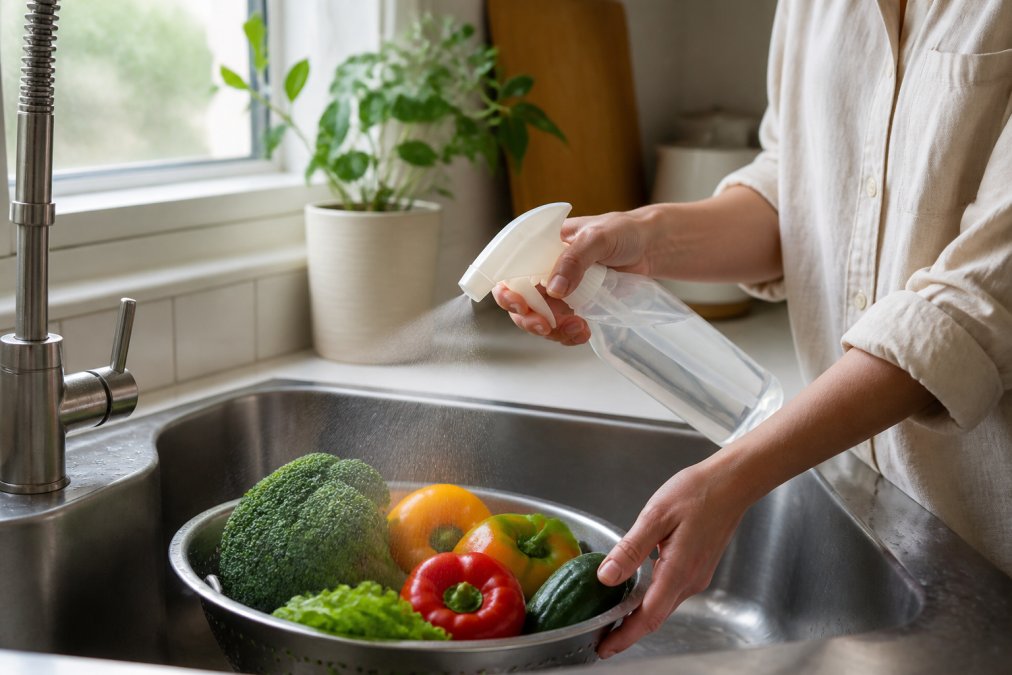
Use HOCl as a no-rinse sanitizer on produce, food-contact surfaces, and equipment when the product is GRAS-compliant and formulated for that use. For meat and poultry, follow the concentration limits set for antimicrobial application rather than improvising your own dilution.
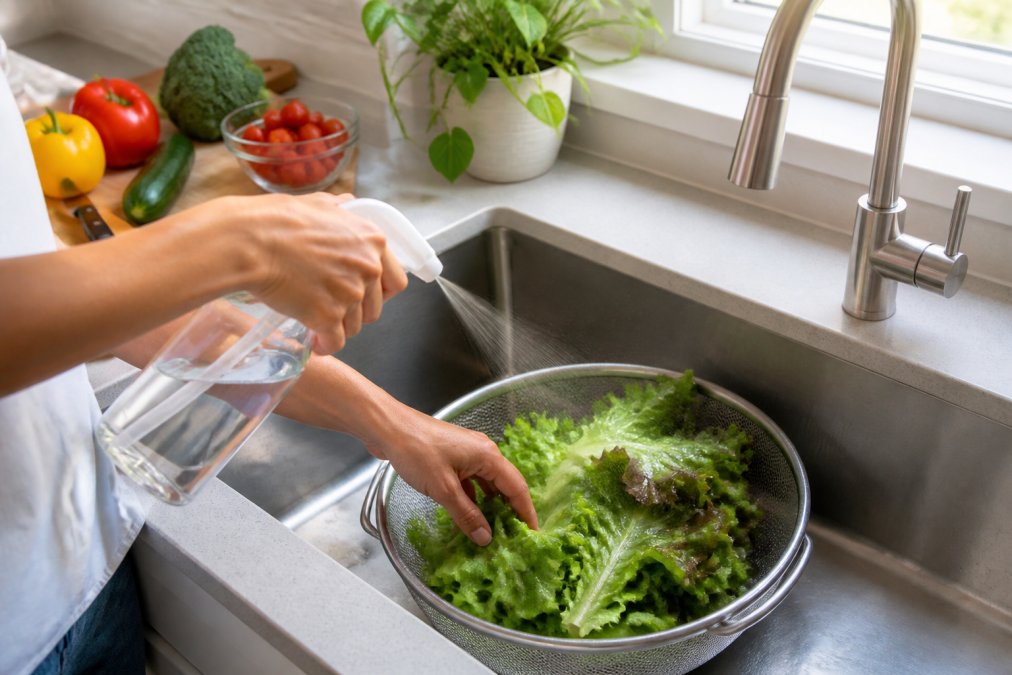
A simple application routine:
- Remove loose dirt and debris from produce with a quick water rinse
- Spray or soak the item with HOCl at the food-contact concentration
- Let it sit for the contact time on the label, usually under a minute
- Shake off excess or pat dry, no potable water rinse needed
- For surfaces, spray, wipe, and let air-dry
Material Compatibility and Shelf-Life Stability
HOCl is safe on most kitchen materials, but "most" is doing real work in that sentence. Here's the surface-by-surface breakdown most guides skip.
Safe for regular contact:
- Stainless steel, the standard for food processing and the material HOCl is most often tested against. No meaningful corrosion at food-contact concentrations.
- Glass and glazed ceramic, inert to HOCl. Safe for soaking jars, bowls, and storage containers.
- Sealed stone and quartz countertops, granite, quartz, and marble with a factory or applied seal handle HOCl well. Unsealed natural stone is porous and can absorb liquid; seal it first or use a different surface.
- Food-grade plastics, HDPE, polypropylene, and most cutting-board plastics (the ones marked with recycling codes 2 and 5) are resistant. Avoid prolonged soaking of soft plastics.
- Silicone, spatulas, mats, and baking liners are unaffected.
Use with caution:
- Untreated carbon steel, knives, woks, and carbon-steel pans will flash-rust with prolonged contact. Wipe and dry immediately rather than soaking.
- Aluminum, bare aluminum (sheet pans, some cookware) can discolor and pit over repeated exposure. Anodized aluminum is more resistant but not immune.
- Cast iron, the seasoned layer is oil-based and HOCl will strip it over time. Don't soak cast iron in any sanitizer.
- Natural wood cutting boards, HOCl won't damage the wood itself, but it can dry and raise the grain with repeated wetting. Oil the board regularly, and don't leave it sitting in a puddle.
- Unsealed porous stone, travertine, unsealed limestone, and some slate can absorb the solution and stain.
Common Mistakes When Using Hypochlorous Acid on Food
The biggest mistake is treating HOCl like a permanent, shelf-stable product. It isn't. Potency fades, and a solution past its working window won't protect your food even though it looks and smells fine.
Other frequent errors:
- Over-concentrating "to be safe." Stronger isn't better on produce. Stick to food-contact concentrations and follow the label.
- Skipping the pre-rinse. HOCl works best on surfaces with reduced microbial load. Rinse off visible dirt first.
- Storing in clear bottles on a sunny counter. UV light breaks HOCl down fast. Use opaque or amber containers.
- Mixing with other cleaners. Never combine HOCl with ammonia-based or acidic products. Even a gentle sanitizer can react badly in the wrong company.
- Assuming all HOCl is food-grade. Production method matters. A product not made for food contact shouldn't touch your produce.
- Ignoring contact time. HOCl is fast, but "fast" still means giving it the seconds the label specifies.
Frequently Asked Questions
Can you wash fruit with hypochlorous acid?
Yes. Hypochlorous acid is used as a no-rinse sanitizer for produce when mixed at the correct concentration, typically 50-200 ppm. It breaks down into salt water and trace chlorine, leaving no harmful residue. Spray or soak fruit and vegetables for 1-2 minutes, then let them air dry or pat dry. Always check the product label for specific produce washing instructions and concentration guidance before use.
Is hypochlorous acid toxic if ingested?
At food-safe concentrations, hypochlorous acid is non-toxic. The FDA recognizes it as Generally Recognized as Safe (GRAS) for food-contact applications at approved levels. However, drinking concentrated HOCl solutions directly is not recommended. When used properly as a produce wash or surface sanitizer, the residual amount left on food is negligible and poses no health risk. Keep concentrated bottles out of reach of children.
Does the FDA approve hypochlorous acid for food contact?
The FDA permits hypochlorous acid as a food-contact sanitizer under specific concentration limits. It holds GRAS status when produced through approved methods and used at or below the allowed parts per million. For produce washing, the FDA allows HOCl at concentrations up to 200 ppm. For food-contact surfaces, it must be applied per the manufacturer's directions and no-rinse protocols. Always verify your product meets FDA compliance.
How does hypochlorous acid compare to bleach for food safety?
Hypochlorous acid is a pH-neutral, non-irritating alternative to bleach. It kills bacteria, viruses, and fungi at lower concentrations than sodium hypochlorite, reducing residual chemical risk on food-contact surfaces. Unlike bleach, HOCl requires no PPE for handling, is safe on most materials, and does not leave harmful byproducts. For kitchen cleaning, HOCl offers comparable pathogen reduction without the harsh fumes or skin irritation of bleach.


