

Last Updated: November 12, 2026
Quick Summary
Dermatologist approved sanitizers for babies are products that have undergone skin-safety testing under a dermatologist's supervision and earned formal acceptance, not just a marketing label. Look for a named certifying body like the National Eczema Association Seal of Acceptance, plus an alcohol-free and fragrance-free formula.
- Dermatologist-tested means testing happened, while dermatologist-approved means a dermatologist formally signed off on the results.
- The National Eczema Association Seal of Acceptance is granted per product, not per brand.
- Do not apply hand sanitizer directly to a newborn's skin unless a pediatrician specifically tells you to.
- Let hands air-dry completely before any contact with a baby.
- The Poison Control helpline is available 24/7 in the U.S. at 1-800-222-1222.
Table of Contents
- What Dermatologist Approved Sanitizers for Babies Actually Mean
- Best Hand Sanitizer Before Touching Baby: What to Look For
- Alcohol-Free Hand Sanitizer for Babies: How HOCl Compares to Ethanol
- Baby Hand Sanitizer Spray: Product Picks for Delicate Skin
- Hand Sanitizer Safe for Newborns: Age Guidance and Safety Precautions
- Accidental Ingestion and Eye Exposure: What Parents Need to Know
- Choosing Your Baby-Safe Sanitizer: A Quick Decision Guide
- Stock Up on Dermatologist Approved Sanitizers for Your Family
- Frequently Asked Questions
What Dermatologist Approved Sanitizers for Babies Actually Mean
Dermatologist approved sanitizers for babies are products that have undergone skin-safety testing under a dermatologist's supervision and earned formal acceptance, not just a marketing label.
"Dermatologist approved" has no single legal definition in the United States, so it's worth reading what actually backs the claim.
Dermatologist-tested vs. dermatologist-approved vs. hypoallergenic
These three terms sound interchangeable. They are not.
Dermatologist-tested means a dermatologist supervised testing, usually a patch test on human volunteers, to check for irritation. It says testing happened. It doesn't guarantee the tester endorsed the product.
Dermatologist-approved goes a step further: a dermatologist reviewed the results and formally signed off. It's a stronger claim, but still self-reported unless a third party verifies it.
Hypoallergenic means the manufacturer believes the product causes fewer allergic reactions.
The takeaway: look for a named certifying body, not just the words on the front of the bottle.
Why the National Eczema Association Seal matters for infant skin
The National Eczema Association Seal of Acceptance is one of the few third-party stamps that means something concrete. To earn it, a product must pass review for ingredient safety and irritant potential, and it's granted per product, not per brand.
For infant skin, which is thinner and loses moisture faster than adult skin, that independent review carries real weight.
Best Hand Sanitizer Before Touching Baby: What to Look For
A gentler hand sanitizer is usually alcohol-free and fragrance-free. Caregivers touch newborns constantly, so residue from a harsh sanitizer can transfer to a baby's face or hands.
A common mistake is assuming "sanitizer is sanitizer." In practice, the formula you use before holding an infant matters more than the one you use at a gas station.
Here's our short checklist for a caregiver's sanitizer:
-
Alcohol-free. No ethanol or isopropyl alcohol that can sting or dry skin.
-
Fragrance-free. Fragrances are a leading trigger for irritation on delicate skin.
-
Third-party accepted. A seal like the National Eczema Association's is a stronger signal than a self-declared claim.
-
Fast-absorbing mist. You want clean hands, not a wet film you transfer to the baby.
What most guides miss is the residue problem. You're not just cleaning your hands, you're cleaning them before they touch the most sensitive skin in the house. Choose accordingly.
Alcohol-Free Hand Sanitizer for Babies: How HOCl Compares to Ethanol
Alcohol-free hand sanitizer for babies relies on non-alcohol antimicrobials, and hypochlorous acid (HOCl) is one of them. HOCl is a molecule produced by white blood cells to fight pathogens. Comparing it with ethanol on mechanism, concentration, and limitations is more useful than treating alcohol-free as automatically safer.
How each one kills germs
Ethanol and isopropyl alcohol kill germs by dissolving the lipid membranes of bacteria and enveloped viruses and by denaturing proteins.
HOCl works through oxidation. Its effect depends on concentration and contact time, and products vary, so read the label for the stated concentration and follow the manufacturer's contact-time instructions rather than assuming all HOCl products are equivalent.
Efficacy and limitations
Alcohol-based sanitizers have a long record of independent testing and are widely referenced by public-health bodies for hand hygiene when soap and water are unavailable. Alcohol-based sanitizers have a long track record, while HOCl is an alternative some caregivers choose for skin tolerance. Neither replaces handwashing with soap and water.
What this means for caregivers
The CDC's hand hygiene guidance is clear that soap and water remain the gold standard for handwashing. For the moments when a sink isn't available, an alcohol-free sanitizer can be a practical option for caregivers.
Watch out: an alcohol-free label does not guarantee a product is safe to apply directly to a baby. Check the full ingredient list and the age guidance above.
For a plain-language explanation of the molecule and why it suits sensitive skin, see our guide to what hypochlorous acid is.
Baby Hand Sanitizer Spray: Product Picks for Delicate Skin
A baby hand sanitizer spray should do two jobs: clean hands fast and stay gentle enough to use around an infant all day. We built our picks around that dual standard, and each one carries the National Eczema Association Seal of Acceptance.
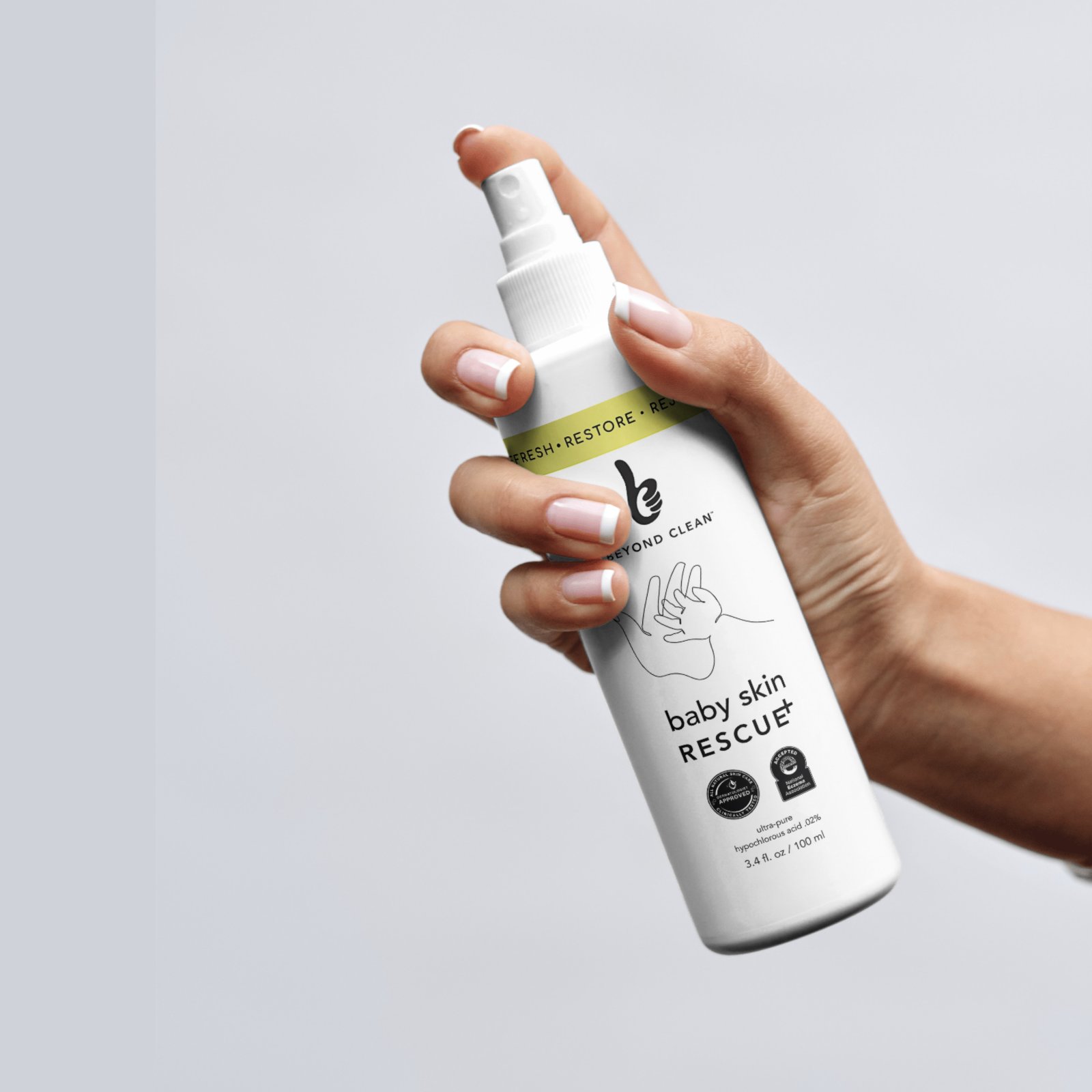
Baby Skin Rescue +
Our pick for direct use on little ones is Baby Skin Rescue + ($14.99). It's a HOCl mist that is alcohol-free and fragrance-free, and it soothes diaper and heat rash without stinging, cleans hands, face, and body between baths, and helps heal minor cuts and scratches. You can shop Baby Skin Rescue + for the full ingredient list.
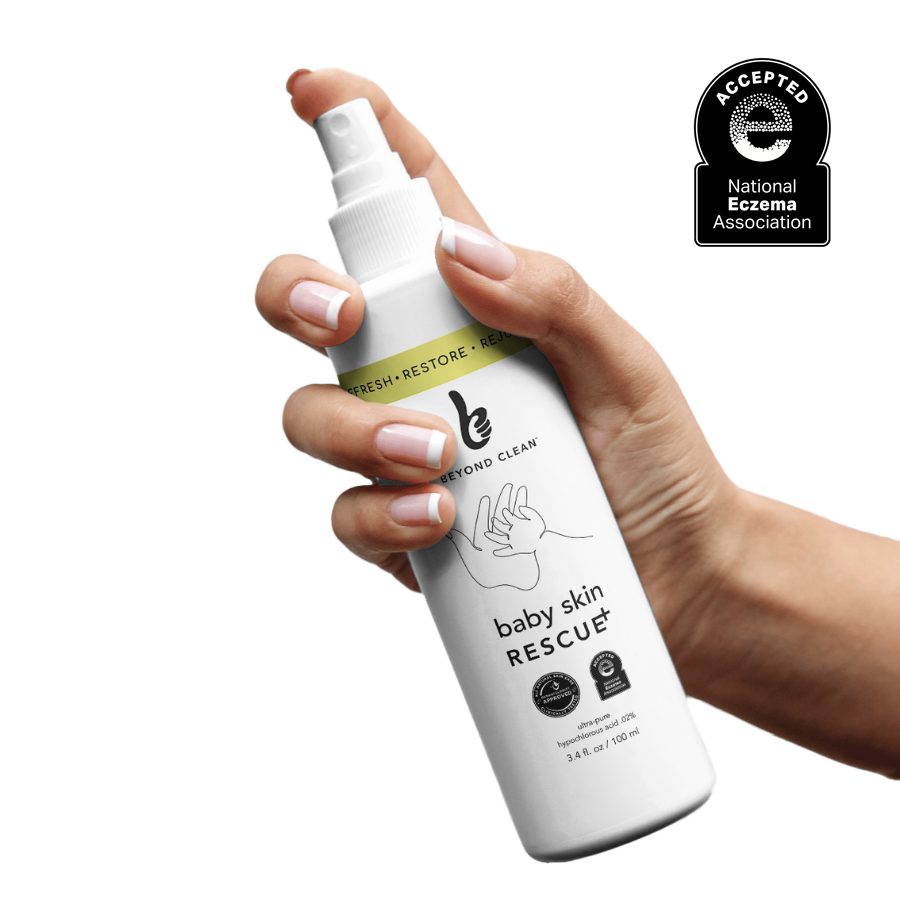
Best for: parents who want one gentle mist for a baby's skin and hands. Skip if: you need a large refill size for a whole household.
Hand & Face Defense+
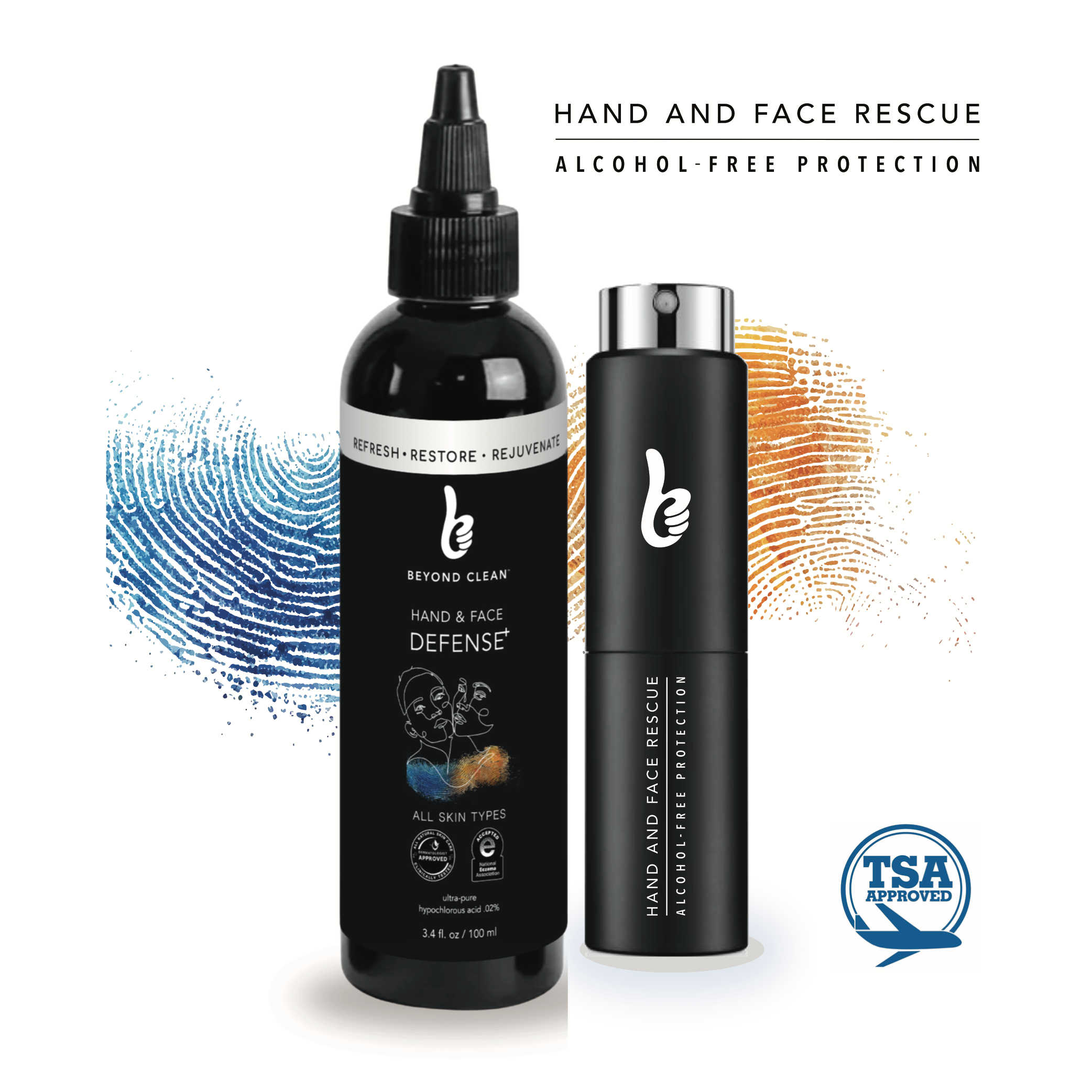
For the caregiver's own hands, Hand & Face Defense+ ($16.99) is a HOCl cleanser in a 3.4 oz TSA-friendly bottle. It's accepted by the National Eczema Association and is a companion for our atomizer.
The bottle is a companion for the atomizer, so you'll want the atomizer for daily carry. See the Hand & Face Defense+ details for how it fits the system.
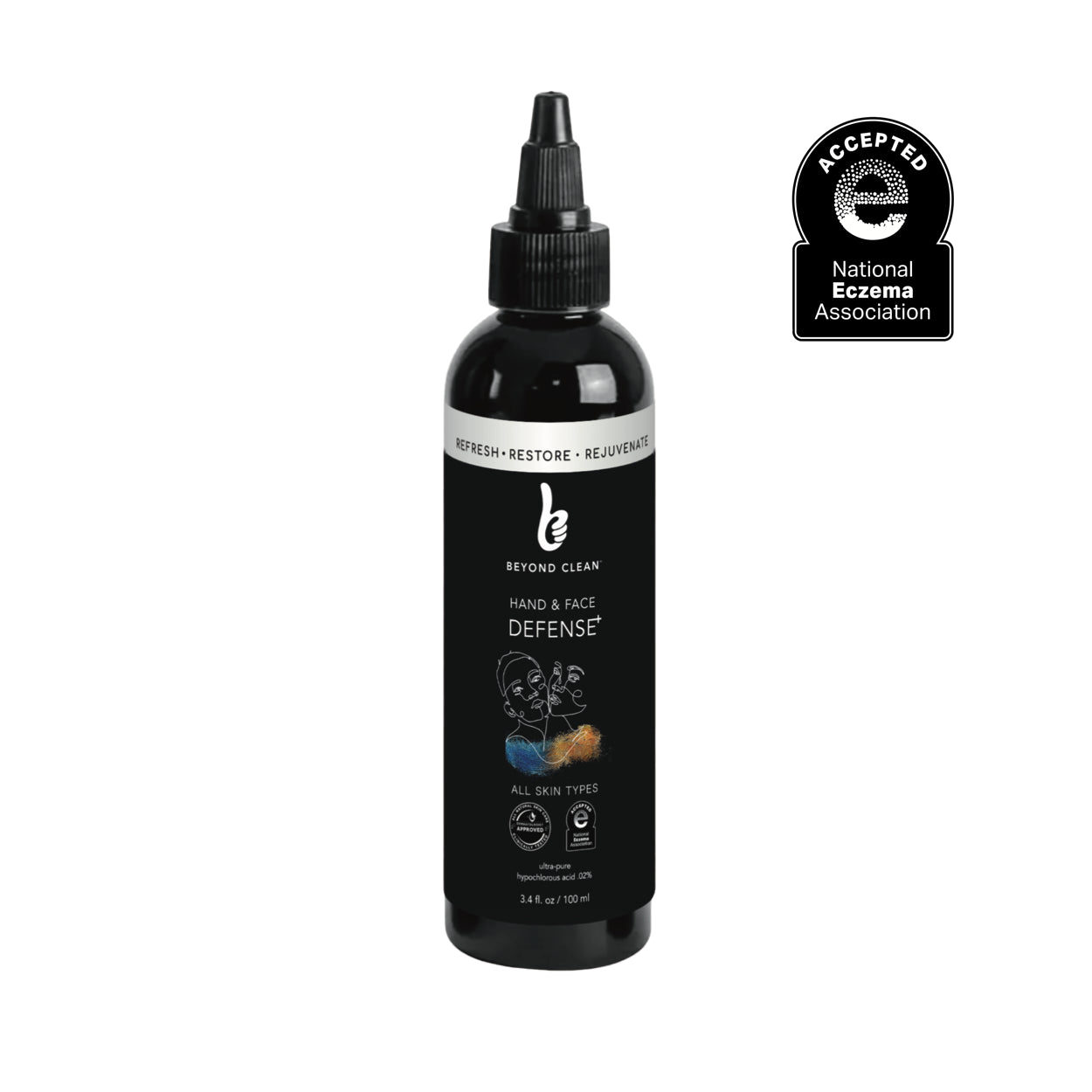
Best for: commuters and parents who sanitize many times a day. Skip if: you prefer a self-contained spray bottle with no device.
Hand & Face Rescue Kit
The Hand & Face Rescue Kit ($49.99) bundles a refillable atomizer with Hand & Face Defense+.
This kit is designed for reuse: refill the glass vial rather than buying a new bottle each time. You can get the Hand & Face Rescue Kit as a complete on-the-go setup.
Best for: families cutting single-use plastic from their routine. Skip if: you want the lowest upfront cost.
Hand Sanitizer Safe for Newborns: Age Guidance and Safety Precautions
Two different questions often get blurred: whether you can sanitize your own hands before touching a baby, and whether you can apply sanitizer directly to a baby's skin. The answers differ by age.
Age-by-age guidance
Newborns to about 6 months. Do not apply hand sanitizer directly to a newborn's skin unless a pediatrician specifically tells you to. Newborn skin is thinner, has a less developed acid mantle, and absorbs more readily than adult skin. The safe routine is to wash your hands with soap and water, or use an alcohol-free, fragrance-free sanitizer on your own hands, and let them air-dry completely before any contact. Handwashing with soap and water is generally the first recommendation around newborns.
About 6 to 12 months. Direct use on a baby's hands is still not routine. Babies at this stage put their hands in their mouths constantly, so any residue is effectively ingested.
About 12 to 24 months. Toddlers touch everything and then touch their faces. Caregiver hand hygiene still matters most.
Preschool and older. School-age children can generally use sanitizer with supervision, but the same priorities hold: soap and water first, alcohol-free and fragrance-free formulas where possible, and adult supervision to prevent ingestion and eye exposure.
Why the caregiver-vs-baby distinction matters
Sanitizer is best thought of as a caregiver tool rather than an infant skincare product. You are cleaning your hands before they touch the most sensitive skin in the house.
Safety precautions that apply at every age
- Let hands air-dry completely before contact with a baby.
- Keep bottles, refills, and atomizers out of reach of toddlers and older siblings.
- Never spray toward a baby's face.
- Patch-test any new product on a small area of skin first.
- Store sanitizer away from food preparation areas.
Watch out: a product labeled baby-safe is not automatically appropriate for direct use on a newborn. The label describes the formula, not the age of the user.
If your baby has a skin condition such as eczema, ask your pediatrician before routine use. This is general guidance, not a diagnosis.
Accidental Ingestion and Eye Exposure: What Parents Need to Know
If a child swallows hand sanitizer or gets it in their eyes, act immediately and contact poison control. In the U.S., the Poison Control helpline is available 24/7 at 1-800-222-1222.
Alcohol-based sanitizers carry a greater ingestion risk because of their ethanol content. Storage matters for any sanitizer.
For eye exposure, rinse with lukewarm water for several minutes and call poison control or a healthcare provider. Keep every bottle, refill, and atomizer on a high shelf.
Choosing Your Baby-Safe Sanitizer: A Quick Decision Guide
Use this guide to match the right product to your situation in under a minute.
| Your situation | Our pick | Price | Why |
|---|---|---|---|
| Direct use on baby's skin | Baby Skin Rescue + | $14.99 | Pediatrician-tested, soothes rash |
| Sanitizing your own hands | Hand & Face Defense+ | $16.99 | Dermatologist approved, TSA-friendly |
| On-the-go, low-waste setup | Hand & Face Rescue Kit | $49.99 | Refillable atomizer, 200+ sprays |
| Refilling an existing atomizer | Hand & Face Defense+ Refill | $39.99 | 8 oz, restores skin's pH |
Price
If you're still deciding, browse the full baby and kids collection to compare sizes and formats side by side.
Stock Up on Dermatologist Approved Sanitizers for Your Family
The gap between a marketing claim and a real safety standard is where most families get burned.
That's the standard we hold ourselves to at Beyond Clean. Our HOCl formulas are clinically tested, dermatologist approved, and National Eczema Association certified, with a refillable atomizer system that cuts single-use plastic.
Sanitizing around a newborn leaves little room for guesswork, and the wrong formula can irritate the most delicate skin in your home.
Frequently Asked Questions
What hand sanitizer is safe for babies?
The safest option for babies is an alcohol-free, fragrance-free sanitizer made with hypochlorous acid (HOCl), which is gentle on delicate skin and doesn't sting. Look for products that are dermatologist-tested, accepted by the National Eczema Association, and pediatrician-recommended, like Baby Skin Rescue +. Avoid alcohol-based gels that can dry out or irritate a baby's skin, and always supervise use on children under two.
Are alcohol-free hand sanitizers safe for babies?
Yes, alcohol-free hand sanitizers can be safe for babies when formulated with skin-friendly ingredients like HOCl. Unlike ethanol, HOCl is a molecule the body's immune system naturally produces. Choose products that are fragrance-free and hypoallergenic, and check for third-party certifications such as the NEA Seal of Acceptance. Always patch-test on a small area first if your baby has very sensitive skin.
Can you use hand sanitizer on a baby's hands?
You can use a gentle, alcohol-free sanitizer on a baby's hands, but with precautions. Avoid alcohol-based sanitizers because babies often put their hands in their mouths, and ingestion can be harmful. Instead, use a baby-safe spray like Baby Skin Rescue +, which is pediatrician-tested and safe from day one. Apply a small amount and let it dry completely before letting your baby touch their face or mouth.
Is soap and water better than hand sanitizer around babies?
Soap and water is the gold standard for hand hygiene when available, as it physically removes germs and dirt. However, when you're on the go or don't have access to a sink, a dermatologist approved sanitizer for babies is a practical alternative. The CDC recommends hand sanitizer with at least 60% alcohol for adults, but for babies and sensitive skin, alcohol-free HOCl-based options are gentler as a sanitizing option.
What does dermatologist-tested mean on a baby product?
Dermatologist-tested means a dermatologist has evaluated the product's ingredients and formula for skin safety, often through patch tests or clinical reviews. It's not a regulated term, so the rigor varies by brand. Dermatologist-approved goes a step further, indicating a dermatologist has formally endorsed the product after testing. For baby products, look for additional certifications like the National Eczema Association Seal of Acceptance to ensure independent verification of gentleness.


