

Last Updated: November 7, 2026
Quick Summary
Hypochlorous acid is a weak acid that works as an oxidizing agent, attacking the cell walls and proteins of germs. It is used in household disinfectant sprays, but results depend on the product, concentration and how long the surface stays wet. Always check the label for the germs it is tested against.
- Read the label and trust only kill claims for the specific germ you need to target.
- Clean heavy dirt off first, since organic matter can reduce how well a disinfectant works.
- Spray until the surface is visibly wet and let it sit for the listed contact time, typically one to ten minutes.
- Hypochlorous acid is generally considered gentler than bleach, but test fabrics on a hidden spot first.
- Store the spray in an opaque container away from heat and sun, and never mix it with other cleaners.
Table of Contents
- What Hypochlorous Acid Is and How It Kills Germs
- Does Hypochlorous Acid Kill Viruses and Bacteria at Home?
- Hypochlorous Acid vs Bleach: Where Each One Fits
- How to Use Hypochlorous Acid for Cleaning, Room by Room
- Choosing a Hypochlorous Acid Disinfectant Spray
- Safety Around Children, Pets, Food Surfaces and Skin
- Limitations, Storage and Shelf Life
- Setting Up a Refillable Disinfecting Routine at Home
- Frequently Asked Questions
What Hypochlorous Acid Is and How It Kills Germs
Hypochlorous acid (HOCl) is a weak acid that your immune system already makes. Hypochlorous acid is also the active ingredient in many modern household disinfectant sprays. Beyond Clean uses it in a fragrance-free, alcohol-free formula that you can refill at home.
Hypochlorous acid is an oxidizing agent. It attacks the cell walls and proteins of microorganisms, which stops them from working.
Does Hypochlorous Acid Kill Viruses and Bacteria at Home?
Hypochlorous acid is used in disinfecting products, but results depend on the product, the concentration and how long the surface stays wet. Always check the label for the specific germs it is tested against.
A few things matter most:
- Read the label. Only products with a stated kill claim for a given germ should be trusted for that germ.
- Keep the surface wet. Spray until the surface is visibly wet, then let it sit for the listed contact time.
- Use it on clean surfaces. Wipe off heavy dirt or food first, since organic matter can reduce how well any disinfectant works.
The Environmental Protection Agency (EPA) registers disinfectant products and publishes the germs each one is approved to kill (the EPA). Check that registration on the label before you rely on a spray for a specific germ, as EPA's list of registered disinfectants.
Hypochlorous Acid vs Bleach: Where Each One Fits
Hypochlorous acid and bleach are both chlorine-based, but they behave differently at home. Bleach is a stronger, harsher option. Hypochlorous acid is generally considered gentler.
Bleach is a strong, well-established household disinfectant. Hypochlorous acid is marketed as a gentler, fragrance-free option for everyday surface care.
How to Use Hypochlorous Acid for Cleaning, Room by Room
A simple routine works best. Clean first, then disinfect, then let it air dry.
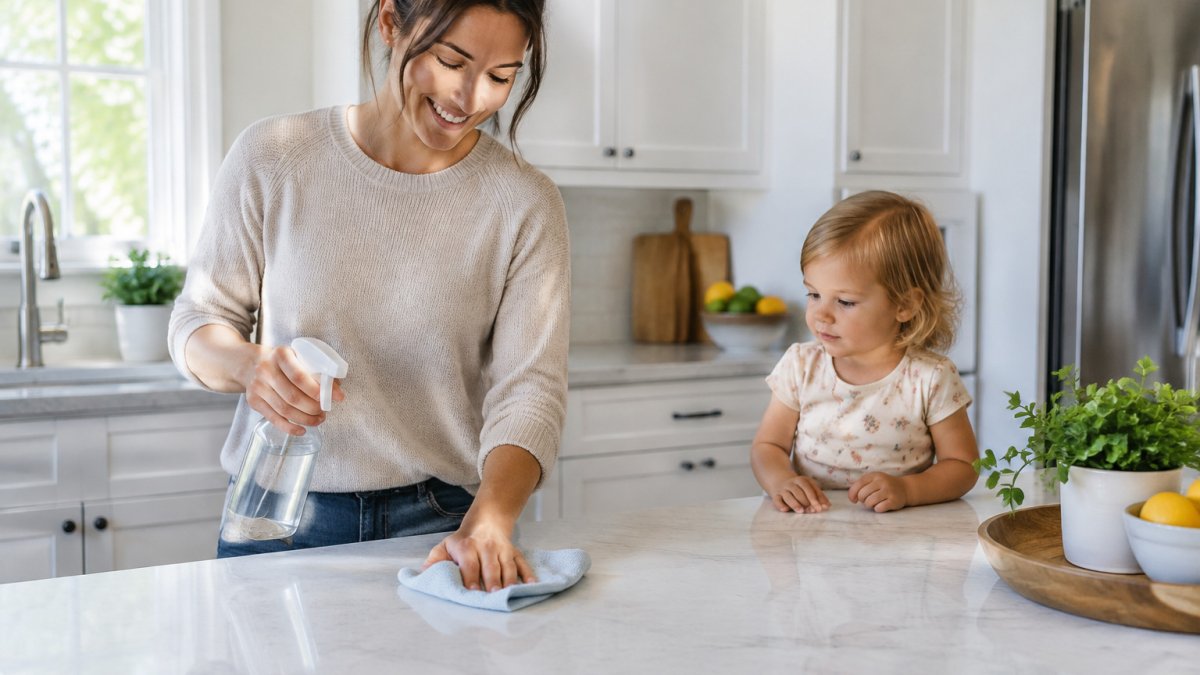
- Kitchen: Wipe counters and the sink, then disinfect after raw meat or poultry. Rinse food-contact surfaces with water before use if the label says to.
- Bathroom: Spray the sink, faucet, toilet handle and shower surfaces. Let them stay wet for the full contact time.
- Living areas: Disinfect remote controls, tablets, door handles and light switches.
- Kids' spaces: Wipe toys and play surfaces, then let them dry before handing them to a child.
!Parent wiping a kitchen counter with a refillable spray bottle while a toddler sits nearby in a bright, tidy kitchen
Contact Time and Surface-Specific Instructions
Contact time is the number of minutes the surface must stay wet for the product to work. Most labels list a time between one and ten minutes.
- Hard, non-porous surfaces (stainless steel, sealed counters, glass): Keep wet for the full listed time.
- Electronics: Spray a cloth, not the device, then wipe gently. Let the surface air dry.
- Fabrics and upholstery: Test a hidden spot first. Hypochlorous acid is gentler than bleach but can still affect some dyes.
- Produce: Rinse with water after spraying if you plan to eat it.
The article lists a simple room-by-room routine, which can be summarised as follows.
| Room | What to disinfect | Key step |
|---|---|---|
| Kitchen | Counters, sink, surfaces after raw meat or poultry | Rinse food-contact surfaces if the label says to |
| Bathroom | Sink, faucet, toilet handle, shower surfaces | Keep wet for the full contact time |
| Living areas | Remote controls, tablets, door handles, light switches | Disinfect frequently touched items |
| Kids' spaces | Toys and play surfaces | Let dry before a child touches them |
Choosing a Hypochlorous Acid Disinfectant Spray
Not every hypochlorous acid spray is the same, and the differences matter more than the marketing copy on the front of the bottle. Two products can both say "hypochlorous acid" and behave very differently on a counter, a cutting board, or a toy.
Check the concentration. Hypochlorous acid products are sold at different strengths, and the label should state the concentration of available chlorine, usually in parts per million (ppm).
Look at pH. Hypochlorous acid is most stable and most effective in a slightly acidic range, and many quality products state a pH on the label or tech sheet.
Ask about freshness and packaging. HOCl loses potency over time, and light and heat speed that loss. Good products ship in opaque or UV-blocking containers, carry a fill or manufacture date, and state a shelf life.
Confirm food-contact and surface claims. If you plan to use the spray on counters, cutting boards, or baby bottles, the label must specifically allow food-contact use. If you plan to use it on electronics or soft furnishings, check that the label lists those surfaces.
Read the ingredient list for fragrance and alcohol. Fragrance-free and alcohol-free formulas are the safer default around children, pets, and people with sensitive skin or respiratory conditions. Added fragrance does not improve disinfection and can irritate.
For a ready-made option, look at Cinagro™ Pro Surface Defense. It is listed as a broad-spectrum sanitizer, non-toxic and non-irritating, and safe on hard surfaces, soft furnishings, food-contact surfaces and electronics when applied as a dry mist.

A quick buyer's checklist:
- Does the label carry an EPA registration number and list the germs it kills?
- What concentration (ppm) and contact time does the label state?
- Does the label disclose pH, a fill date, and a shelf life?
- Is the container opaque or UV-blocking?
- Is food-contact use explicitly allowed?
- Is the formula fragrance-free and alcohol-free?
Watch out: a spray sold as a "sanitizer" and a spray sold as a "disinfectant" are not interchangeable, sanitizers reduce germs to a defined level, while disinfectants must meet a higher kill standard, so match the product class to the job.
Safety Around Children, Pets, Food Surfaces and Skin
Hypochlorous acid is generally considered gentle, but it should still be used with care. Keep these habits in mind:
- Children: Store the spray out of reach. Let disinfected surfaces dry before kids touch them.
- Pets: Keep pets out of the room while you spray, and wipe food and water bowls with clean water after disinfecting.
- Food surfaces: Only use products labeled for food contact on counters where you prepare food, and rinse if the label says to.
- Skin: Wash hands after use. If you have a skin condition, test on a small area first.
Watch out: Never mix hypochlorous acid with other cleaners, especially those with ammonia or acids. Mixing can release harmful gases.
Limitations, Storage and Shelf Life
Hypochlorous acid is a useful household tool, but it is not a cure-all, and it is less forgiving than bleach in one important way: it loses strength over time. Understanding where it falls short and how to store it keeps you from relying on a spray that has gone flat.
Where HOCl should not replace another method:
- Heavily soiled surfaces. Dirt, grease, and food residue consume the active chlorine before it can reach germs. Clean first with soap or detergent, then disinfect. On a greasy stovetop or a soiled toilet bowl, HOCl is the wrong first step.
- Confirmed outbreaks or a sick household member. For norovirus, C. difficile, or other pathogens that require a specific registered disinfectant, follow public health guidance rather than assuming a general HOCl spray is sufficient. The Centers for Disease Control and Prevention (CDC) publishes situation-specific guidance, as CDC guidance on cleaning and disinfecting homes.
- Porous materials. Unsealed wood, porous stone, and thick fabrics can absorb the solution and may not stay wet for the full contact time. Test a hidden spot and follow the label's surface list.
- Situations requiring a registered disinfectant. If the label does not list the germ or the surface, do not substitute hope for a claim.
Storage that protects potency:
- Light. Store in an opaque or UV-blocking container, away from windows and direct sun. Clear bottles degrade faster.
- Heat. Keep it out of hot garages, cars, and cabinets above the stove. A cool, dark closet is better than a warm utility room.
- Air and container type. Keep the cap sealed when not in use. Decanting into a dirty or reactive container can reduce potency; use a clean, labeled spray bottle.
- Mixing. Never mix HOCl with other cleaners, especially ammonia or acids. Beyond the gas hazard, mixing can also neutralize the solution.
Shelf life and loss of potency:
HOCl is typically sold with a stated shelf life, and potency declines faster once the container is opened and exposed to air. Treat the label's expiration date as the outer limit, and treat an opened bottle as having a shorter useful window. A common pattern is to use opened bottles within weeks rather than months, but follow the maker's stated guidance over any general rule. If the spray no longer smells faintly of chlorine or no longer keeps a surface wet for the listed contact time, replace it rather than stretching it.
Label the date. Write the fill or open date on each bottle so you are not guessing. Rotate stock so older bottles get used first, and replace concentrate before its expiration date.
Watch out: a bottle that has been sitting in a hot car or a sunny windowsill may look fine but have lost much of its potency, when in doubt, replace it rather than trusting it on a food-contact surface.
Setting Up a Refillable Disinfecting Routine at Home
A refillable system cuts down on plastic waste and keeps your supplies on hand. Set up a simple routine:
- Keep one spray bottle in the kitchen and one in the bathroom.
- Refill from a larger container when the bottle runs low.
- Label each bottle with the date you filled it.
- Replace the concentrate before its expiration date.
Our team at Beyond Clean recommends picking one area each week to deep-clean, so the whole home stays on a steady schedule.
Ready to make a switch? Start with a refillable bottle of Cinagro™ Pro Surface Defense and use it for the surfaces you touch most. Beyond Clean makes it easy to keep your home clean without harsh fragrances or extra plastic.
Frequently Asked Questions
How do you use hypochlorous acid for household cleaning?
Spray or wipe the solution onto a clean surface, then leave it wet for the contact time listed on the product label before wiping or air drying. Start by removing visible dirt, since organic matter can reduce how well any disinfectant works. For high-touch items like doorknobs, faucets and countertops, apply until the surface is evenly wet rather than just misted. Use a fresh spray on food-prep surfaces and rinse with water where the label directs. Beyond Clean's Cinagro Pro Surface Defense is a ready-to-use solution that can be applied directly from the bottle.
Does hypochlorous acid kill viruses on household surfaces?
Hypochlorous acid is marketed for antimicrobial activity against bacteria, viruses and fungi, but how well it works depends on the concentration, the surface and how long it stays wet. Product labels list the organisms they are tested against and the contact time required, so check those claims rather than assuming broad coverage. Cinagro Pro Surface Defense states it eradicates 99.99% of bacteria, fungi and viruses. Keep the surface wet for the full contact time to get the result the label describes.
Is hypochlorous acid better than bleach for household disinfection?
Bleach is a strong, well-established disinfectant but has a sharp odor, can discolor fabrics and must be handled with gloves and ventilation. Hypochlorous acid products are generally fragrance-free. It may not be the right choice for every heavy-duty job, so the better option depends on the surface, the target germs and how much cleaning power you need. Check each product's label for the organisms it covers.
Is hypochlorous acid safe to use around children and pets?
Cinagro Pro Surface Defense is listed as non-toxic and non-irritating. Even so, let surfaces dry before children or pets touch them, keep bottles out of reach, and avoid spraying directly onto food or into eyes. For skin conditions or allergies, check the product label and talk with your pediatrician or dermatologist before regular use.


